
The first job to hand to AI is one that a single person does regularly and that takes 15 to 20 minutes each time. It starts from a file or text you already have, its steps could be explained to a new colleague, and there is a point where a person checks the result. If you have several jobs like that, you rank them with a simple formula: how many times a week, how many minutes, how many people, and how cleanly the job passes three tests.
Picture a building materials trader with 20 employees that has bought AI licences for everyone. A month later a few people use them to rewrite emails and the rest never open them. The managing director has a list of 20 jobs AI "could do" and no idea which one to start with. The company is made up, but there are plenty like it. The rest of this article uses the method to pick three of its twenty jobs.
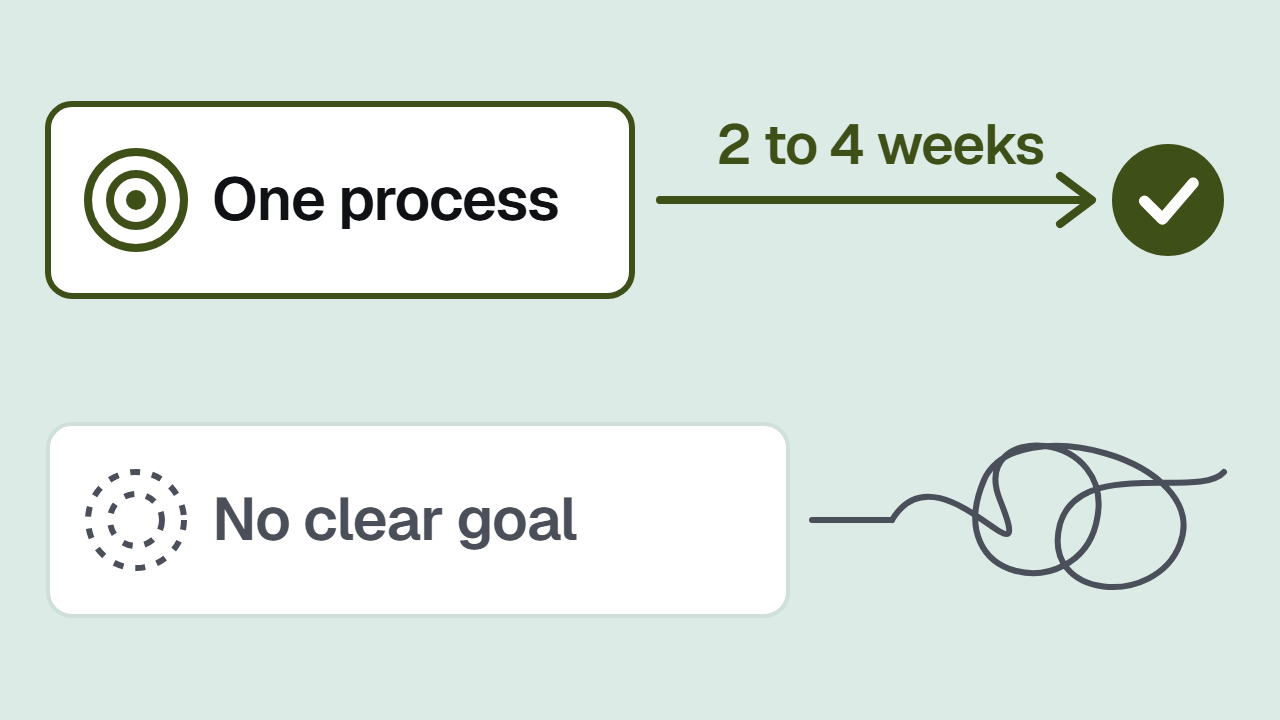
- Start with one job. It has a named person, a fixed rhythm, a file at the start and a file at the end.
- A good first job takes 15 to 20 minutes each time. A job shorter than 10 minutes rarely repays the setup. A job longer than 40 minutes usually has several jobs hiding inside it.
- Three tests, and it must pass all of them. The input is digital, you could dictate the procedure to a new colleague, and there is a natural point where a person checks the result.
- The formula. Score = frequency × minutes × people × confidence.
- Pick three jobs. At least one easy, at most one hard, three different people, and one whose result a client sees.
Why "roll out AI" goes nowhere
"Roll out AI" is not a task. On Monday morning nobody knows what exactly to do with it, so everyone tries something of their own, and within a few weeks most people are back to the old way. The licences get paid for and the work carries on as before.
The job to start with is much narrower. Say a salesperson builds a price quote every day in the company's Word template, from a client's email and the price list. For a job like that you can write instructions, add the price list and the template, and the next morning the salesperson is already using it. Claude calls this a project: the instructions and files are set up once, and each run is one chat. Once the first job is in place, the second is easier to start, because the team has seen how it works.
What a 15 to 20 minute job is
We mean a job that one named person does on a fixed rhythm (daily, weekly or monthly). It starts from digital input they already have, follows steps you could dictate to a new colleague, and ends with a file or text that someone else uses. Today one run takes 15 to 20 minutes.
Count the minutes per run, not per week. You write the instructions once, and the time is saved on every run. How often the job repeats goes into the formula below.
A job under 10 minutes rarely pays. Opening a chat, uploading the file and checking the result take time too, and on a short job that eats the whole gain.
A job over 40 minutes usually needs splitting. A job that long almost always hides more than three steps. Cleaning up a supplier's Excel file and turning the same file into a PDF quote are two jobs, and each is better set up on its own.
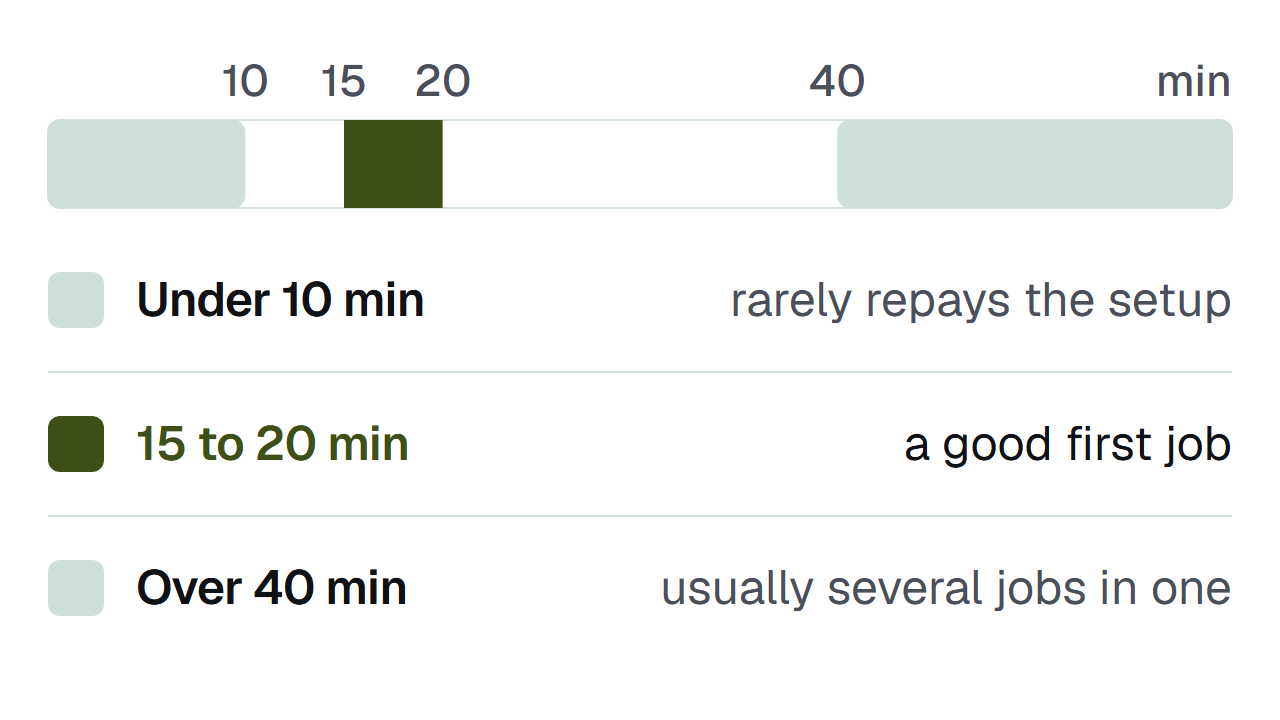
These limits come from our own experience, not from a study. A job that takes 12 or 45 minutes can still work; it just deserves a closer look.
Three tests
A job has to pass all three.
The input is digital
Every input is a file or text a person can drop into a chat: Excel, CSV, Word, PDF, an image or the text of an email. Paper, a phone call, or data that sits in a system with no way to export it, fail the test. If the data can only be pulled out of a system by hand each time, the job passes the test with a workaround, and the formula marks the job down for it.
You could dictate the procedure to a new colleague
The person who does the job can write the steps down as sentences, together with the rules they decide by: thresholds, exceptions, column names, tone. Ask them how they decide. If the answer is "I just know", that is expert judgement. You can keep a job like that, but AI only prepares the decision in it, and a person makes it.
There is a natural checkpoint
There is a moment when a person reviews the result before it leaves the company or goes into a system. For example, the reconciled list before it is posted, or the quote before it goes to the client. If there is no such moment, the job is either so simple that it needs no AI, or too risky to hand over unchecked.
Two more signs that a job fits. Someone other than the person doing it uses the result, so someone will notice if it is late. And the shape of the result repeats even though the content changes every time.
A formula you can work out with a pencil
Score = frequency × minutes × people × confidence
- Frequency is runs a week. Monthly is 0.25, weekly is 1, every working day is 5.
- Minutes is how long one run takes today, as estimated by the person who does it. The most you count is 40, even if it takes longer.
- People is how many do the job or wait for its result. The most you count is 3, so that one job everyone shares does not drown out the rest.
- Confidence is 1 if all three tests pass cleanly. It is 0.5 if one test passes only with a workaround, for example someone exporting data from a system by hand every time. It is 0 if any test fails.
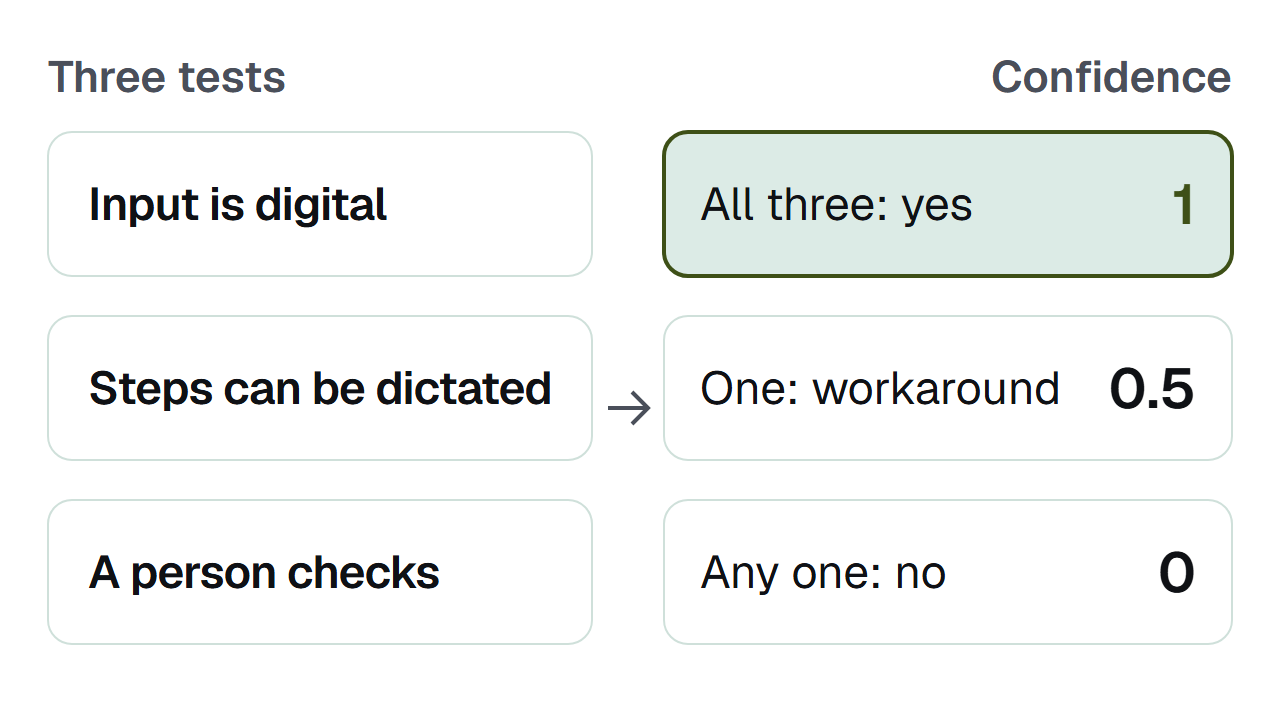
The first three numbers multiplied together are the minutes a week the job takes today. Confidence weeds out the jobs that will never make it into daily use.
In our made-up company, three candidates look like this:
| Job | Frequency | Minutes | People | Confidence | Score |
|---|---|---|---|---|---|
| Bank reconciliation, one accountant | weekly, 1 | 20 | 1 | 1 | 20 |
| Price quote from a client request, two salespeople | daily, 5 | 15 | 2 | 1 | 150 |
| Five-step month-end closing pack, data exported from a system by hand | monthly, 0.25 | 40 | 1 | 0.5 | 5 |
The quote wins by a wide margin even though each run is shorter than the reconciliation, because two people do it every day. A score of 150 means 150 minutes, two and a half hours a week. The bank reconciliation is a solid second. The closing pack is the longest of the three and scores only 5: it happens once a month, it has five steps, and one of them runs through a workaround. Better to split it into smaller jobs or leave it for later.
The score does not promise a saving. Some of the time will go on checking, so use the score to compare jobs with each other.
What rules a job out straight away
Some jobs score 0 however often and however long they run.
- It has to run with no person involved. For example, a morning report nobody checks, or an inbox that has to be watched around the clock. That is a different kind of automation, and it is set up separately.
- The result has to go into a system with no ready connection to AI. For example, accounting software where data can only be typed in by hand. A bridge like that is built as a separate project.
- The input is scans or photos of handwriting. There are often so many errors that checking takes longer than the job itself. A PDF created digitally is fine.
- The result is a regulated decision. Whether to hire someone, a salary figure, a legal classification. Turn a job like that into preparation, or drop it. Comparing CVs against the job requirements works if a person makes the decision.
- The person cannot explain in one sitting how they decide. Then the job fails the procedure test.
Pick three
Once the jobs are ranked by score, take the top ones and check them against six rules.
- At least one easy job. All tests pass cleanly, the input is one file, and the gain shows on the first run. It shows the team the method works.
- At most one hard job. Hard means a workaround, many files or images. One is enough to learn from.
- Three different owners. That way three people learn to work with AI, and if one goes on holiday, the other two jobs carry on.
- One result a client sees. A quote, a report or a letter. It shows that AI can produce a file in your template and in your tone.
- The owner wants it. If no one has said "I'd like to run this", leave the job on the list for later.
- The input is already in your hands. Prefer jobs whose files you already export every week. If the first step is "ask the supplier for a better file", the job will wait on the supplier.
In the made-up company, the first two would be the price quote, whose result the client sees, and the bank reconciliation, which is the easy one. The third would come from the rest of the list and should belong to a different person, someone in the warehouse, say. The other candidates do not disappear. Keep the list, and once the first three jobs are in place, take the next one.
How to find the candidates: ask about the last time
Ask an employee "how does this work?" and you hear how it is supposed to work. Ask instead: "Show me how it went the last time." Then the real steps come out: the file that arrived by email, the column renamed by hand, the call to a colleague because an item was missing from the price list. Those are the steps that decide whether the job passes the tests and how many minutes it takes.
For each candidate, ask for three to five real pairs of files: what the person received and what they passed on. Without them you cannot check whether the AI's result is right.
One table is enough for the whole list: job, person, how often, how many minutes, where the input comes from and where the result goes. Put the score in the last column.
What to do this week
- Write down every job AI "could do", and next to each the person who does it.
- Walk through the last time each person did the job, and note the minutes and the frequency.
- Check the three tests and the rule-outs, then work out the scores.
- Pick three jobs using the six rules, and name an owner for each.
This is also how we pick the jobs in Pamats: we talk to the team, work out the scores, and choose three everyday processes together with you, each with its own owner. We set them up in Claude, hand them over to the team and review them after 30 days.
If you would like to work out the scores with us, book a free 30-minute call and bring one Excel file you hate. On the call we look at the job behind it and whether it would make a good first one. You do not have to buy anything afterwards.