
A sea container travels from the port of Riga to the warehouse on a tractor unit, and a consignment note goes with it. If the goods continue to another country, it is a CMR note. If they stay in Latvia, the CMR convention does not apply, but a consignment note is still needed.
This article covers when you need a CMR note, why the boxes are numbered differently on two forms, what goes in each box, the deadlines for damage claims, the e-CMR status in Latvia, sea container sizes and how much a container may weigh on the road.
- A CMR note is needed for international carriage of goods by road for reward, when the goods are taken over in one country and delivered in another.
- Carriage within Latvia is not covered by the CMR convention, but the Latvian Road Transport Act requires a consignment note with similar content in at least three copies.
- There are two forms. On the current IRU model (2007) the carrier is in box 6, on the widely used older form in box 16. Only boxes 1, 2 and 21 to 24 have the same numbers.
- Damage: note visible damage on the consignment note at delivery, report hidden damage in writing within 7 days.
- Containers: a 20-foot container takes 11 EUR pallets, a 40-foot one 24 to 25.
When you need a CMR note
The CMR is the 1956 Convention on the Contract for the International Carriage of Goods by Road. Latvia acceded to it in 1994. The convention applies to a carriage when all four conditions are met:
- it is a contract for reward;
- the goods are carried by road vehicle;
- the goods are taken over in one country and delivered in another;
- at least one of those countries is a party to the convention.
A container going from the port of Riga to a warehouse in Ķekava is domestic carriage, and the CMR convention does not apply. Article 9 of the Latvian Road Transport Act (Autopārvadājumu likums) still requires a consignment note: the sender prepares it in at least three copies, and both the sender and the carrier sign it. The content is almost the same as a CMR note, and for intermodal carriage the weight of the container must be stated too. The Act does not prescribe a form, and in practice the CMR form is often used for this as well. Ask your carrier which form it accepts.
If a container with goods from outside the EU leaves the port before customs clearance, it travels under a customs procedure, which a customs broker usually handles.
Two forms: why the boxes are numbered differently
The convention sets the content of the consignment note (article 6), not the form. The International Road Transport Union (IRU) drew up a model in 1976 and revised it in 2007. Both kinds of form are in circulation, and their boxes are numbered differently. If someone says "put it in box 16", check which form you have first.
| Content | IRU 2007 | Widely used older form* |
|---|---|---|
| Sender | 1 | 1 |
| Consignee | 2 | 2 |
| Place and date of taking over | 3 | 4 |
| Place of delivery | 4 | 3 |
| Sender's instructions (customs etc.) | 5 | 13 |
| Carrier | 6 | 16 |
| Successive carriers | 7 | 17 |
| Carrier's reservations | 8 | 18 |
| Documents attached | 9 | 5 |
| Goods: marks, number of packages, packing, description, weight, volume | 10 to 15 | 6 to 12 |
| Special agreements | 16 | 19 |
| To be paid by | 17 | 20 |
| Cash on delivery | 19 | 15 |
| Place and date made out | 21 | 21 |
| Signatures: sender, carrier, consignee | 22, 23, 24 | 22, 23, 24 |
*Based on a widely used form. On some older forms the content of boxes 14 and 15 differs.
The CMR note box by box (IRU 2007)
Below are the boxes of the current IRU model and who usually fills them in. The sender fills in most of them. The carrier fills in its own box, the reservations and its signature, the consignee only the last box.
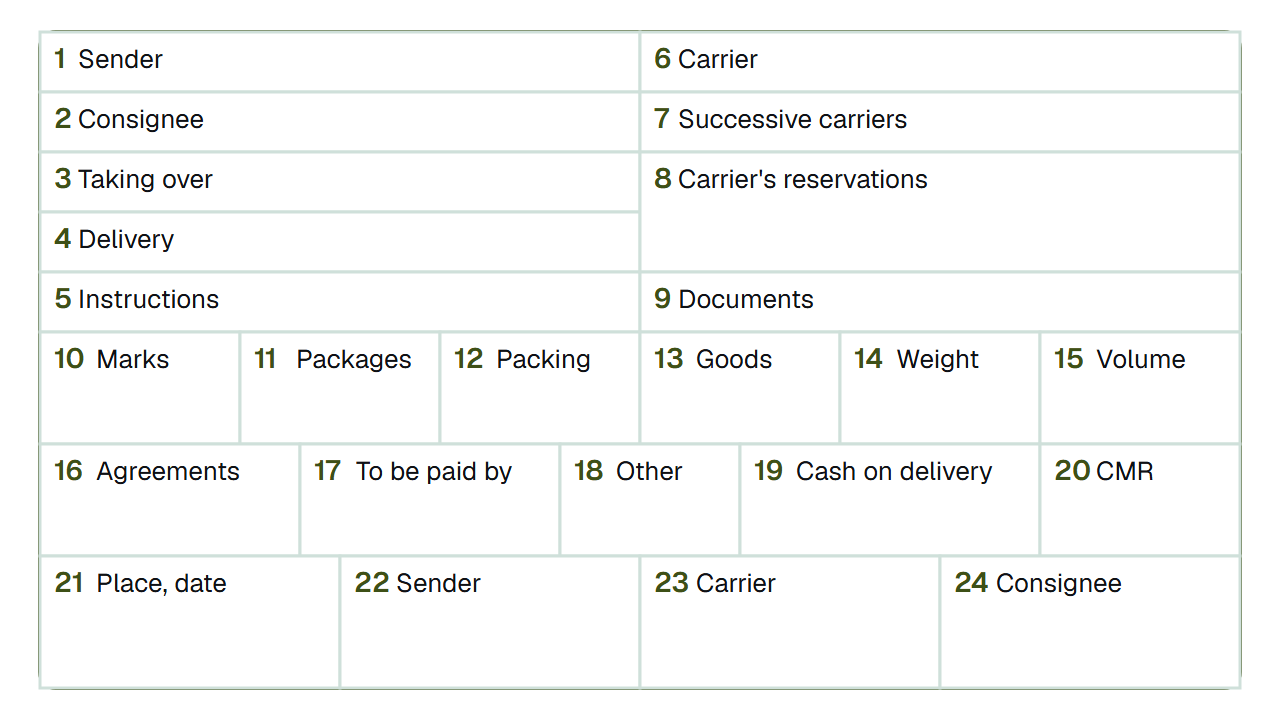
| Box | What goes in | Who fills it in |
|---|---|---|
| 1 | Sender: name, full address, country | Sender |
| 2 | Consignee: name, full address, country | Sender |
| 3 | Taking over the goods: place, country, date. The IRU recommends also noting arrival and departure times, in case waiting time has to be proven later | Sender and carrier |
| 4 | Delivery: place, country, warehouse opening hours | Sender |
| 5 | Sender's instructions: customs, no transhipment, insurance | Sender |
| 6 | Carrier: name, address, country | Carrier or sender |
| 7 | Successive carriers, if several carry the goods | Each successive carrier |
| 8 | Carrier's reservations about the condition of the goods, the packing, the number of packages | Carrier, sender countersigns |
| 9 | Documents the sender hands to the carrier | Sender |
| 10 | Marks and numbers | Sender |
| 11 | Number of packages | Sender |
| 12 | Method of packing | Sender |
| 13 | Nature of the goods (for dangerous goods also the UN number and class) | Sender |
| 14 | Gross weight, kg | Sender |
| 15 | Volume, m³ | Sender |
| 16 | Special agreements: declared value, delivery time limit, pallets, who loads | Sender and carrier |
| 17 | To be paid by: carriage charges, supplementary charges, customs duties | Sender or carrier |
| 18 | Other useful particulars: vehicle registration, customs document number | Either |
| 19 | Cash on delivery, if the carrier is to collect money | Sender |
| 20 | Printed text: the carriage is subject to the CMR | Printed |
| 21 | Place and date made out | Sender |
| 22 | Sender's signature or stamp | Sender |
| 23 | Carrier's signature or stamp | Carrier (driver) |
| 24 | Goods received: place, date, time, consignee's signature and stamp | Consignee |
A consignment note with blank boxes stays valid if the sender or the carrier has signed it (IRU). Even if the note is missing or irregular, the contract of carriage stands and the CMR applies (article 4). Still, in most countries the note must be in the vehicle, and its absence can be fined.
Copies, reservations and signatures
The convention requires three originals (article 5): the first goes to the sender, the second travels with the goods, the third stays with the carrier. The IRU model is printed in four colours: red for the sender, blue for the consignee, green for the carrier, black for administrative use.
In a dispute, two boxes are looked at most often.
- Carrier's reservations (box 8). If the carrier enters no reservations, the goods and their packaging are presumed to have been in apparent good order and the number of packages, marks and numbers correct (article 9). For a sealed container whose contents the driver cannot check, the IRU says a reservation must be entered.
- Consignee's signature (box 24). If the consignee signs without remarks, the goods are presumed to have been received in the condition described in the note, unless the contrary is proven (article 30).
Damage or loss: deadlines and liability
| Case | Deadline (CMR article 30) |
|---|---|
| Visible damage or shortage | Note it on the consignment note at delivery |
| Hidden damage | In writing within 7 days of delivery, not counting Sundays and public holidays |
| Late delivery | In writing within 21 days from when the goods were placed at the consignee's disposal |
The limitation period for claims is one year, or three years in the case of wilful misconduct (article 32). The carrier's liability is limited to 8.33 units of account (the International Monetary Fund's Special Drawing Rights, SDR) per kilogram of gross weight short (article 23). A higher amount can be claimed if a value of the goods or a special interest in delivery is declared in the note.
e-CMR in Latvia
Sources often contradict each other on the electronic CMR, because they mix up three different things.
- For international carriage, e-CMR is legally allowed in Latvia. Latvia ratified the e-CMR protocol in 2010, and it has been in force since 2011.
- The national system has not officially launched yet. In 2022 the Ministry of Transport planned e-CMR from 2024 and in full from 2026, but by November 2026 we found no official announcement that the register is running.
- On the road, paper is still the safer choice. In March 2026 the trade press reported that drivers in Latvia may still be asked for a paper CMR.
Across the EU, from 9 July 2027 authorities must accept freight information electronically from certified eFTI platforms.
Sea container sizes
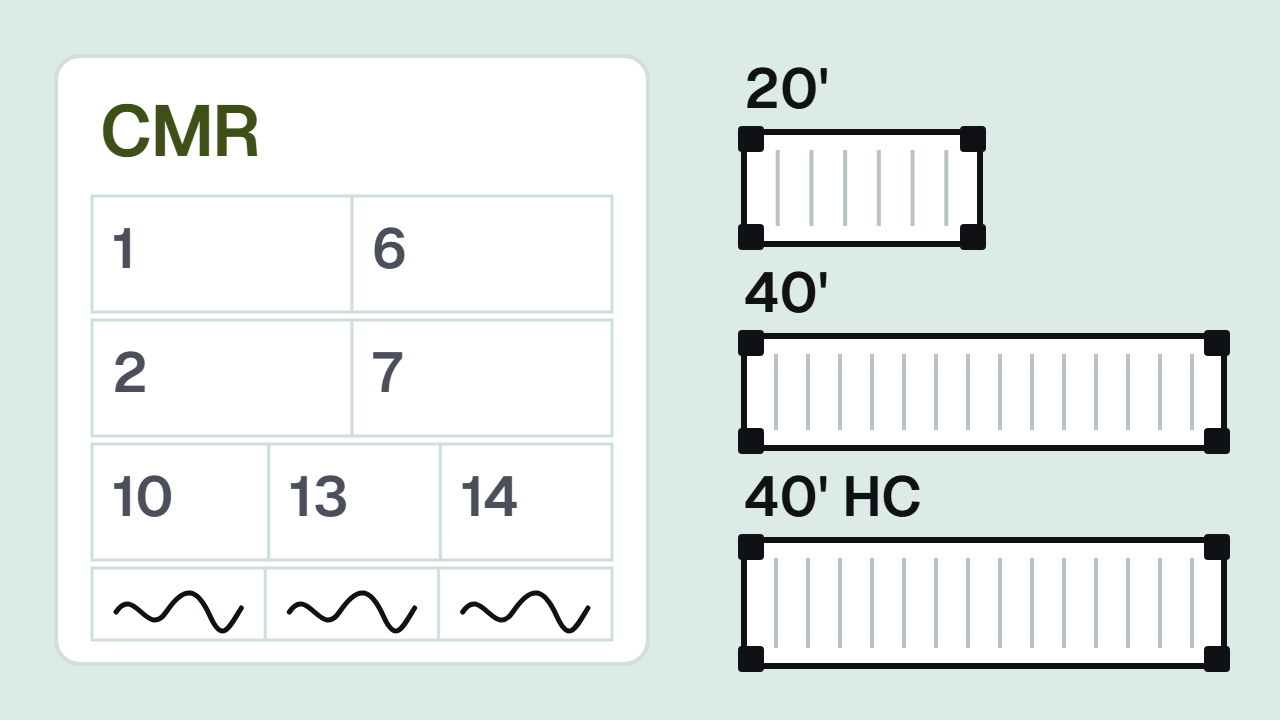
Dimensions vary slightly from one container to another by manufacturer, so the table shows typical values. Check the container's plate or the line's specification for exact figures.
| Container | Internal dimensions (L × W × H) | Door (W × H) | Volume | Tare | Payload |
|---|---|---|---|---|---|
| 20' | 5.90 × 2.35 × 2.39 m | 2.34 × 2.28 m | ~33 m³ | ~2.3 t | ~25 t |
| 40' | 12.03 × 2.35 × 2.39 m | 2.34 × 2.28 m | ~67.7 m³ | ~3.75 t | ~27.6 t |
| 40' High Cube | 12.04 × 2.35 × 2.70 m | 2.34 × 2.59 m | ~76 m³ | ~3.9 t | ~26.5 to 28.5 t |
| 45' High Cube | 13.56 × 2.35 × 2.70 m | 2.34 × 2.59 m | ~86 m³ | ~3.9 t | ~29 t |
Externally, all standard containers are 2.438 m wide. A High Cube is about 30 cm taller, and its floor area is the same.
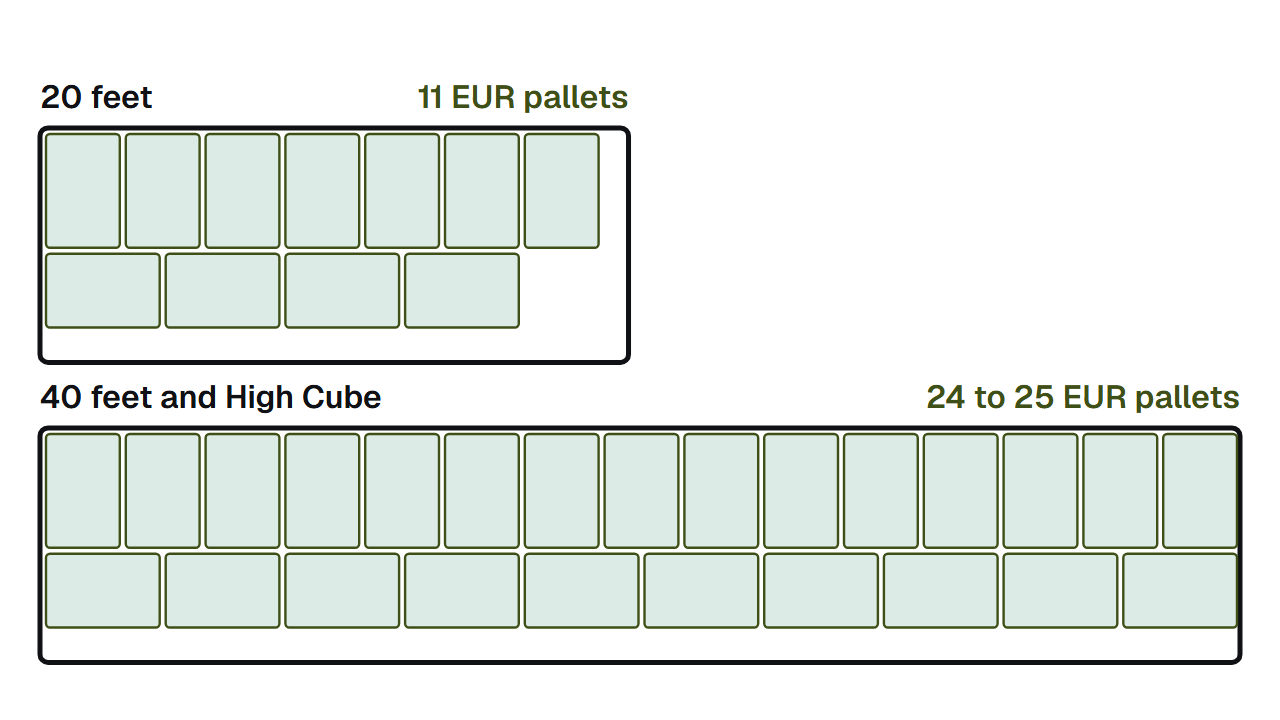
| Container | EUR pallets (1200 × 800) | Industrial pallets (1200 × 1000) |
|---|---|---|
| 20' | 11 | 9 to 10 |
| 40' and 40' High Cube | 24 to 25 | 20 to 21 |
| 45' High Cube "pallet wide" | ~33 | no data |
Pallets are counted in a single layer. The internal width of a standard container is less than 2.4 m, so two EUR pallets cannot stand side by side with their long sides across.
A container from the port to the warehouse
Weight on the road. The usual maximum gross weight for a tractor unit with a semi-trailer is 40 t. In Latvia a container up to 45 feet in intermodal transport may be carried at up to 42 t with a two-axle tractor and a three-axle semi-trailer, and up to 44 t with a three-axle tractor (Road Traffic Regulations, Annex 2, points 8.13 and 8.14). The tractor, the semi-trailer and the container itself come off that, so the legal load on the road is often less than the container could take. Ask your carrier whether your trip from the port counts as intermodal and how much may be loaded, and check the current version of the annex on likumi.lv, as amendments have been drafted.
Time. Once the container leaves the terminal, the detention free time starts (some lines count it together with demurrage) and runs until the empty container is returned. The bill of lading decides who gets the invoice, and the sales contract decides who finally pays. We wrote about this in Incoterms 2020: who pays when a container sits in port.
With a few containers a month, arrival times and free days can be tracked in a spreadsheet. When containers come from several lines, each with its own deadline, the spreadsheet falls behind the real status. For one international trading and freight group, the first data clean-up cut the list of shipments with no free-day data from about 400 rows to about 109. How we set this up for your company is described on the page Container tracking.
Frequently asked questions
Do I need a CMR for carriage within Latvia? The CMR convention applies only to international carriage. Within Latvia you need a consignment note under article 9 of the Road Transport Act. The Act does not prescribe a form, and in practice the CMR form is often used as well.
Which CMR form is correct, the 2007 one or the older one? Both. The convention sets the content, not the form. What matters is that everyone means the same form when they mention a box number.
Does a CMR need a stamp? The convention requires the signatures of the sender and the carrier. On the IRU model, boxes 22 and 23 have room for a signature or a stamp, and in box 24 the consignee usually puts both. Ask your partner whether a signature alone is enough for them.
How many pallets fit in a 40-foot container? 24 to 25 EUR pallets or 20 to 21 industrial pallets in a single layer. A High Cube has the same floor area.
Can I use e-CMR? For international carriage, legally yes, as Latvia has ratified the protocol. In practice it is still safer to carry a paper copy on the road until the national system and eFTI are fully running.