
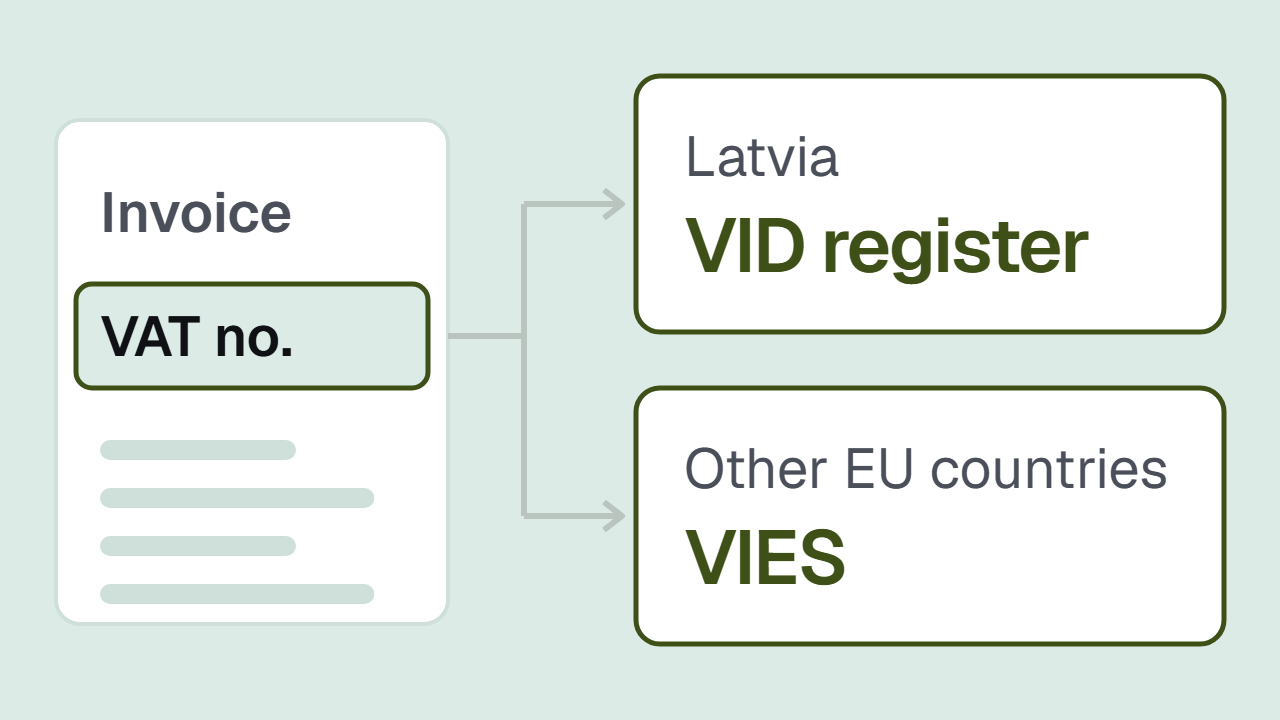
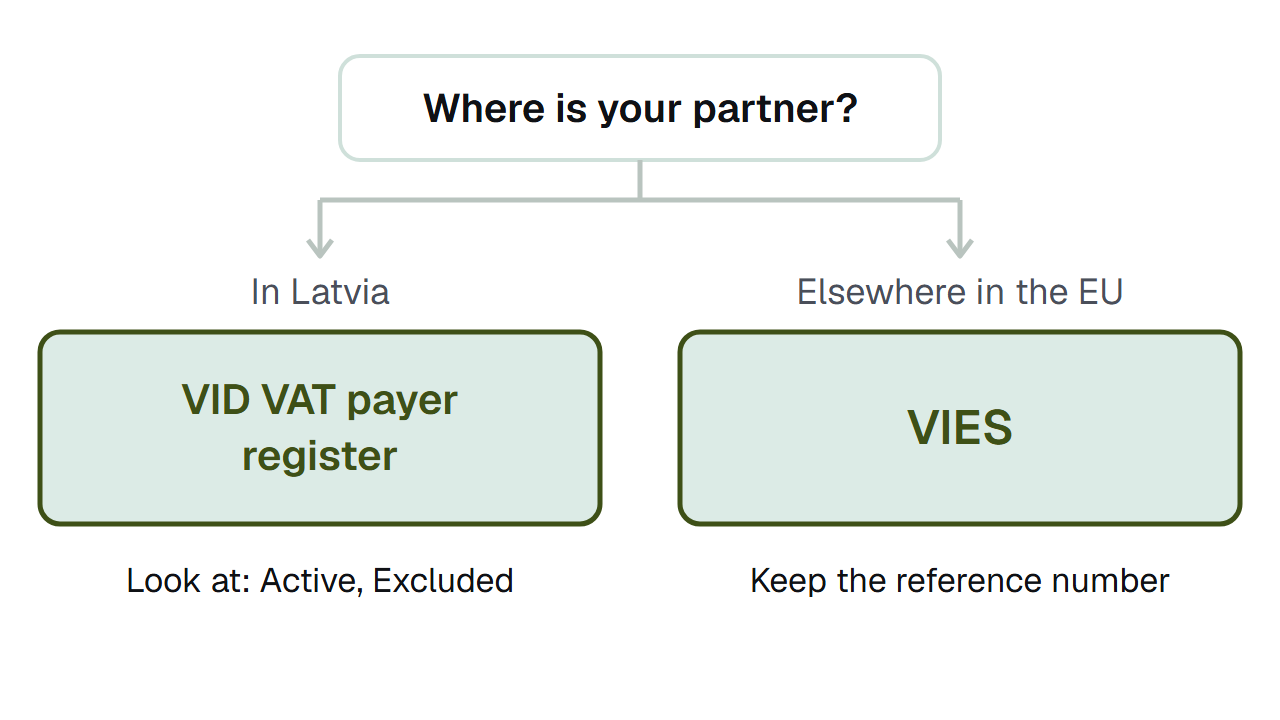
A VAT number is checked in one of two places. A Latvian supplier is checked in the VID VAT payer register, a partner in another EU country in VIES, the European Commission's system. Both checks are free and take a few seconds. The answer is the harder part: it is not always clear what it means and what to do when the number is not valid.
Below are both checks step by step, every possible answer, what to do when an invalid number means 21 % instead of 0 %, how to keep proof of the check and how often to repeat it.
- Latvian supplier: the VID VAT payer register. Enter the 11 digits without "LV" and look at the columns "Aktīvs" (active) and "Izslēgts" (excluded).
- Partner in another EU country: VIES. Choose the country, enter the number, and give your own VAT number under "Requester Member State" to get a consultation number.
- Buying: you can only deduct the VAT on an invoice issued by a registered VAT payer, and checking that is your duty.
- Selling in the EU: 0 % on goods applies only if the buyer's number is valid at the time of the transaction. If it is not, Latvian 21 % applies in principle.
- Proof: keep the VIES consultation number or a printout of the check with the invoice for at least five years.
Which check to use
VIES passes your question to the tax administration of the country that issued the number and shows whether the number is valid for trade with other EU countries. VIES finds Latvian numbers too. When you buy from a Latvian supplier, though, what you need to check is whether they are in the VID VAT payer register, and the VID register shows that.
Latvian supplier: the VID VAT payer register
- Open VID's search, Pievienotās vērtības nodokļa maksātāji (the page is in Latvian only).
- Enter the 11 digits without "LV" (it is already printed in front of the field) and press "Atlasīt" (search).
- Read the row. The columns are Numurs (number), Nosaukums (name), Aktīvs (active), Reģistrēts (registered) and Izslēgts (excluded).
If "Aktīvs" says "ir" (yes) and "Izslēgts" shows "-", the supplier is a registered VAT payer. If "Izslēgts" shows a date, the VAT on an invoice issued after that date usually cannot be deducted as input VAT. If the number is not found at all, check the digits on the invoice and ask the supplier.
Under the table the page shows when the data was last updated. If you have many suppliers, the same list can be downloaded as the open data file "PVN maksātāji" on data.gov.lv, updated every day.
VID recommends checking a partner more widely: whether their business activity has been suspended, whether they owe tax, and their taxpayer rating. If you skip this, VID may take the view that you did not act with due care.
Partner in another EU country: VIES
- Open VIES.
- Under "Member State / Northern Ireland", choose the country that issued the number. For Greece it is "EL", not "GR".
- Under "VAT Number", type the number without the country code, spaces or dots.
- Under "Requester Member State / Northern Ireland", choose Latvia and type your own company's VAT number next to it.
- Press "Verify".
Step four is optional, but without it you get no consultation number. It appears in the row "Consultation Number". The VIES help page advises keeping this number on file if you want to prove to a tax administration that you checked a given number at a given time and got a given answer.
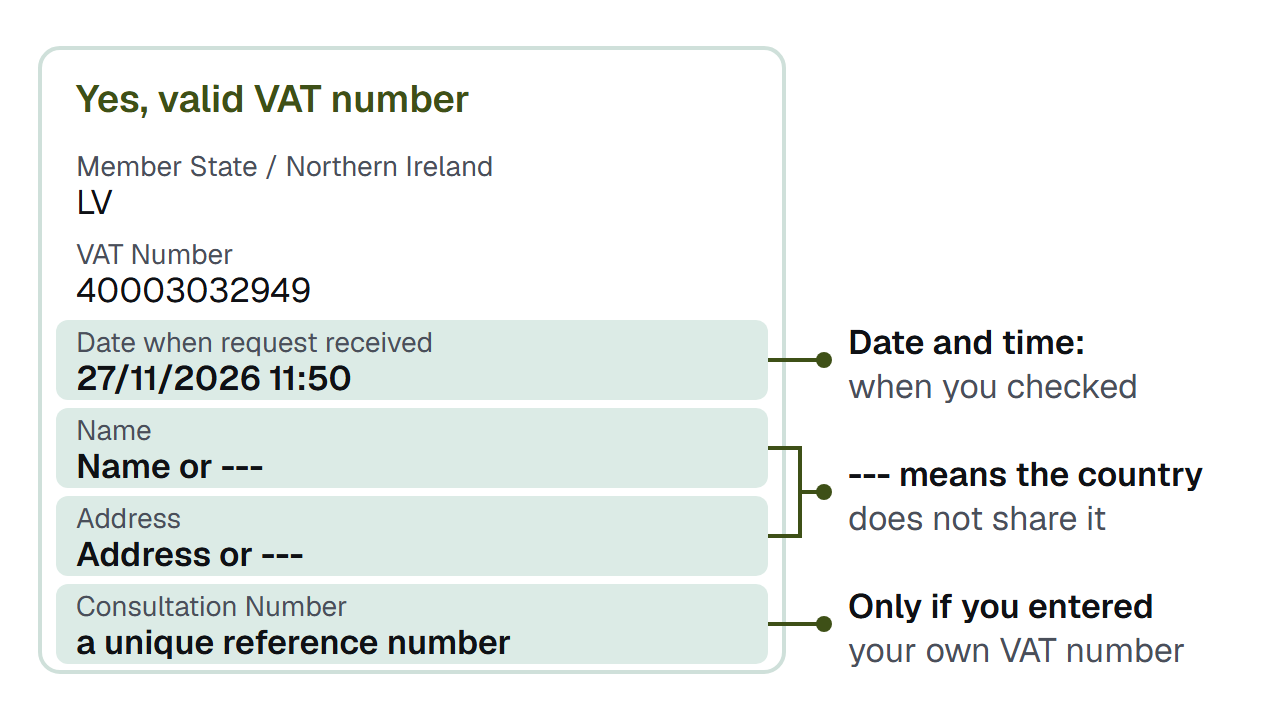
Some countries do not disclose the name and address for a valid number. The fields then show "---". VIES shows both for a Latvian number, for example, but not for a German one.
What each answer means and what to do
The VIES help page lists six possible answers. They mean three different things: the number is valid, the number is not valid, or the check did not work this time.
| Answer | What it means | What to do |
|---|---|---|
| Valid VAT number | The number is valid for EU trade today | Keep the consultation number or a printout with the invoice |
| VAT number not valid | The number is not valid, at least today. It may not exist or may not be activated for EU trade, or registration may not be finished | Check the country and the digits, then ask the partner. They can confirm it with their own tax administration |
| System not working | A technical fault in the network or software | Try again later. The number has not been found invalid |
| That country's database not working | That country's database is not available right now, for example during planned maintenance | Try again later. Maintenance times are on the VIES help page |
| Error: incomplete or incorrect data | Wrong country or an empty field | Check what you entered |
| No reply received | The answer did not arrive in time | Try again later |
VIES shows an invalid number with the same message even when the number does not exist at all. So the message alone does not tell you whether there is no such number or it is simply not activated for EU trade. Before you conclude that a partner is not a VAT payer, ask them.
When an invalid number changes the rate: 0 % or 21 %
Goods to another EU country. Article 43(4) of the Latvian VAT Act allows 0 % only if the buyer gave a valid VAT number from another member state at the time of the transaction and the goods actually leave Latvia. Since 2020, 0 % also does not apply if the supply is missing from, or wrong in, your EU sales report and you cannot justify this to VID (Article 51(6)). If the number is not valid, the condition for 0 % is not met, and in principle the standard 21 % applies.
Services to a business in another EU country. If the customer is a business with a valid number, the place of supply is usually the customer's country, and the invoice must say "nodokļa apgrieztā maksāšana" (reverse charge). Without a valid number the customer can be treated as a non-taxable person, and then Latvian VAT usually applies. Some types of service have their own rules, so talk this case through with your accountant.
Buying from a Latvian supplier. For purchases in Latvia, input VAT is the VAT shown on invoices from registered VAT payers (Article 92(1), point 1). The law says outright that you must make sure the invoice was issued by a registered taxpayer (Article 92(6)). Exclusion from the register takes effect on the day the decision is deemed notified, and an appeal does not suspend it (Article 74(2)). A supplier who was registered last month may already be excluded today.
Buying from an EU supplier. For goods and services from another EU country, the buyer usually accounts for the VAT (reverse charge) and can deduct the same amount as input VAT.
How to keep proof of the check
The European Commission recommends keeping a record of the check in case of a tax audit. In practice there are three ways:
- The VIES consultation number, if you entered your own VAT number. This is the form the VIES help page recommends as proof.
- The result page as a PDF with the date and time visible, where there is no consultation number, for example for a VID register check.
- A note on the invoice in your accounting software: when it was checked, who checked it, and what the answer was.
Keep the proof with the invoice. Invoices are kept for five years from the invoice date (Article 133(4) of the VAT Act), and it makes sense to keep the proof of the check for as long. A valid number is only one piece of evidence for 0 %, as the VIES help page also points out. For goods you also need the transport documents (Article 43(4)).
How often to check
We found no official rule on how often a number has to be checked. The law requires the buyer's number to be valid at the time of the transaction, and VIES confirms validity only for the day of the check. A practical routine:
- check every new supplier and customer before the first transaction;
- check an EU customer before every invoice at 0 % or under the reverse charge;
- check a Latvian supplier before deducting the VAT on each invoice. With many suppliers, it is easier to do this with the data.gov.lv file, which is updated every day.
If your own number shows as invalid
Check that your partner chose LV under "Member State" and entered all 11 digits. If the number was issued recently, it may take a while to show up in VIES. If the number is valid in the VID register but not in VIES, contact VID. VID's page on checking other EU numbers gives the address [email protected].
When hundreds of invoices need checking
With a handful of suppliers, checking by hand is enough. When hundreds of invoices arrive each month from dozens of suppliers, the manual check is the first thing to be skipped. Both checks have official machine-readable sources: VIES has a free API, and VID's list of VAT payers is published daily on data.gov.lv. So the supplier's number can be checked in the same step that reads the invoice, and the invoice flagged if the number is not valid. How each invoice is read and compared with the document is in our article Supplier invoices and Shopify orders into accounting, automatically. How we set this up for your company is described on the page Invoice processing.
Frequently asked questions
Is the registration number the same as the VAT number? For a Latvian company, the VAT number is usually "LV" followed by its 11-digit registration number. But not every company is a VAT payer, so a registration number does not mean a valid VAT number.
Why does VIES not show the name of a German company? Germany, like some other countries, does not disclose the name and address in VIES. For a valid number, "---" in those fields only means the country does not share that information.
What if a customer says their number is valid but VIES says it is not? Ask the customer to confirm it with their own tax administration. A number can be registered but not activated for EU trade. Until VIES shows the number as valid, do not apply 0 %, and go through the invoice with your accountant.
Do I need to check a regular supplier? Yes. Exclusion from the VAT register takes effect immediately, and the duty to check applies to every invoice you deduct VAT from.
Can VIES check a UK number? No. Of UK numbers, VIES checks only Northern Ireland numbers with the prefix "XI".