
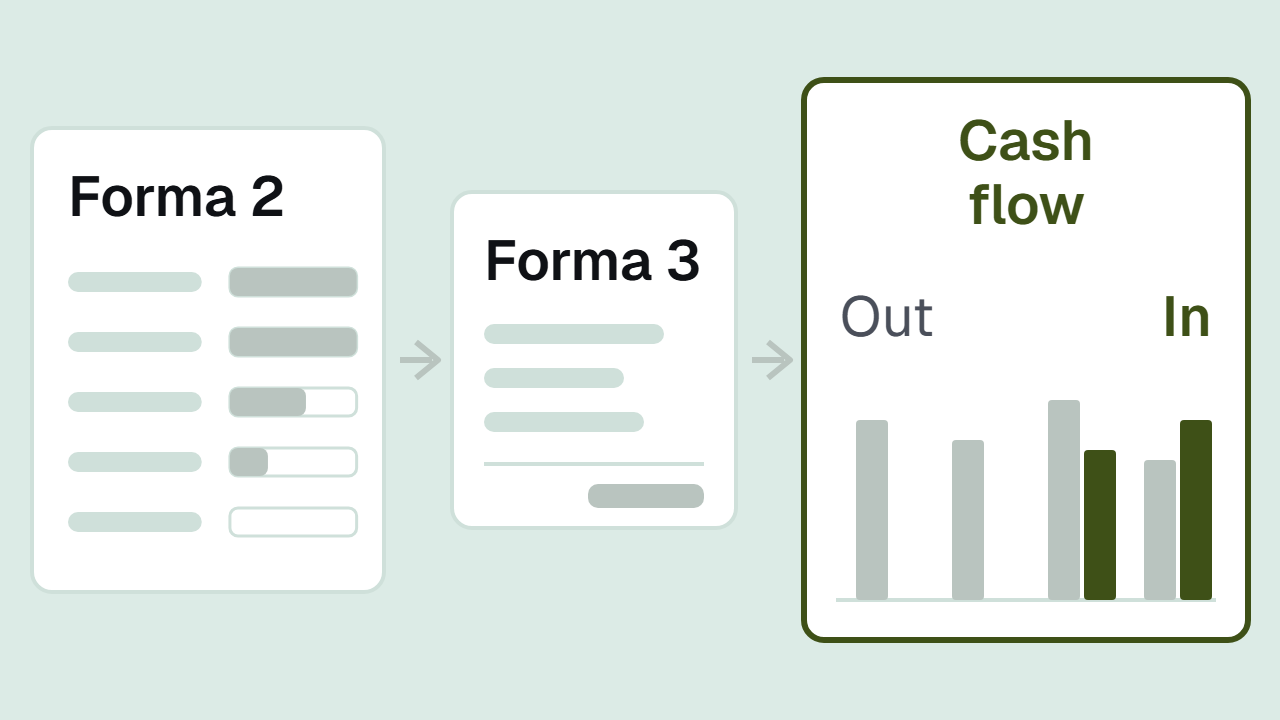
Every month a Latvian construction company prepares an act of completed works, known in the trade as Forma 2, and its summary, Forma 3. The client signs them, and the company invoices from them.
The same numbers hold something many companies only learn after a site is handed over: what the site really costs, and when the money for the work will arrive. Here are both forms column by column, the deadlines, a free Excel sample, and how to read a site's cash flow from the act.
- Forma 2 is the monthly act of completed works: every line of the estimate with what was done this month and in total since the start.
- Forma 3 is the act's summary: what is payable for the month after the advance and the retention are deducted. The invoice follows it.
- No law defines these forms. They come from contracts, so columns and deadlines can differ from one contract to the next.
- In public works contracts the act is due every month, by the 10th at the latest (Cabinet Regulation No. 419).
- If you write the actual costs next to Forma 3, you see the site's profit and cash flow every month, not after handover.
What Forma 2 and Forma 3 are
Both forms rest on the estimate (tāme). The estimate says which works the site needs, in what quantity and at what price. The act says, every month, how much of it has been done.
Forma 2 is the act of completed works. It has the same lines as the local estimate, and each line records how much was done in earlier months, how much this month, and how much in total. The client uses it to check that the works submitted for payment were really done.
Forma 3 is the summary of completed works. It no longer has every line, only the totals per estimate or type of work: the contract price, what was done this month, in total, and what is left. Below the table come the deductions and the amount payable. The invoice cites the act's number and period.
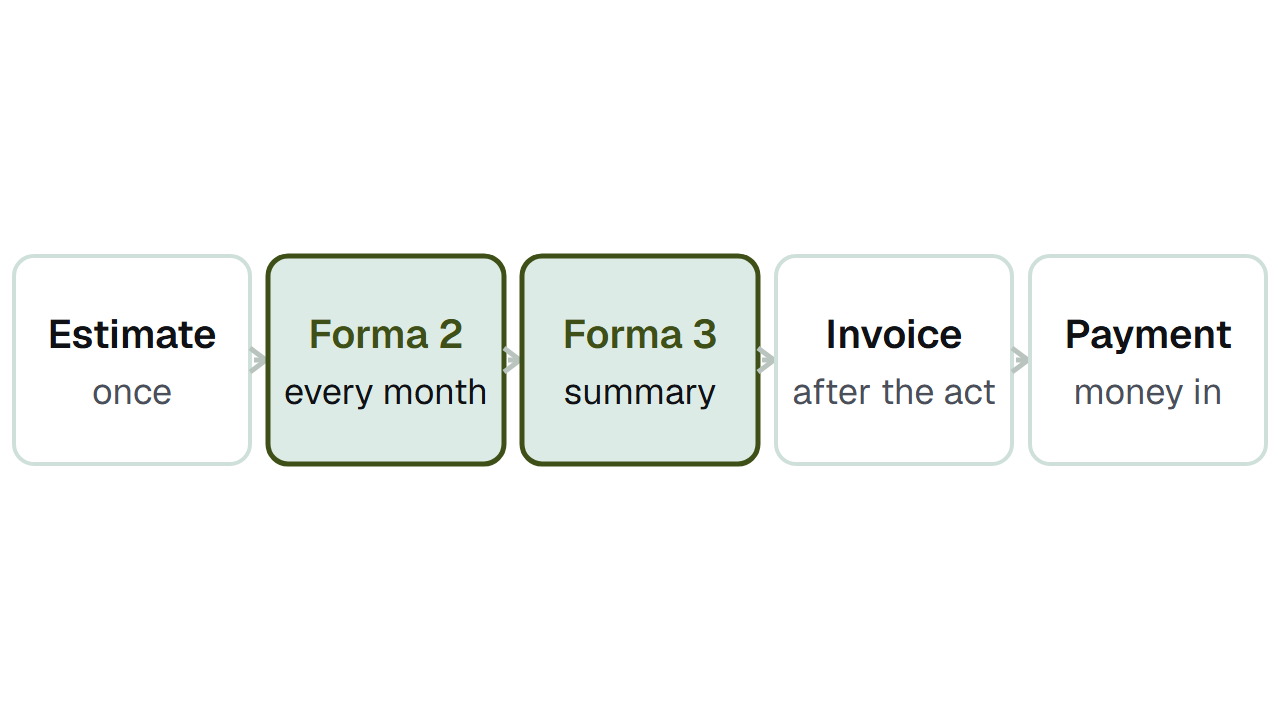
The names "Forma 2" and "Forma 3" appear in no law and no Cabinet regulation. The estimate's form is set by the building standard LBN 501-17, but each client puts its own act form in its contract. So before you fill in any sample, ours included, check the contract's annexes for a form of the client's own.
Forma 2: columns and how to fill it in
At the top: act number, period (from, to), contract number and date, site, client, contractor and estimate number.
In the table, for each estimate line:
- No., code, name of the work and unit, exactly as in the estimate.
- Quantity, unit price and amount per the estimate.
- Done before: the quantity from earlier acts.
- Done this period: quantity and amount.
- Done in total since the start: quantity and amount.
- Percentage done and balance: how much of the estimate is still to do.
At the bottom, signatures: the contractor's site manager, the client and, if the contract asks for it, the building supervisor (būvuzraugs).
Each month you only need to enter one number per line: how much was done this period. The rest follows from the estimate and the previous act. One check is a must: the total done may not exceed the quantity in the estimate. If there is more work, that is additional work, and it needs its own estimate or a contract amendment.
Forma 3: from the act to the invoice
The Forma 3 table has one row per local estimate or type of work: contract price, done before, this period, in total since the start, balance and percentage done.
Below the table, the amount payable, step by step:
- Done this period.
- Minus the advance. If the client paid an advance, each act deducts it in proportion.
- Minus the retention. The client keeps part of the amount until the warranty period ends. In public contracts it is at most 5% of each act.
- Amount payable.
- VAT. If both you and the client are VAT payers in Latvia, construction services use the reverse charge. The invoice then carries no VAT, only the note "nodokļa apgrieztā maksāšana". For a private person, VAT is added as usual.
The sample has four sheets:
- Tāme (estimate): paste your estimate lines: code, name, unit, quantity, unit price.
- Forma 2: each month enter only the quantity done this period. The rest calculates itself, and a line turns red if more is done than estimated.
- Forma 3: the summary with the advance and the retention deducted. Enter the percentages from your contract.
- Naudas plūsma (cash flow): work done against actual costs, month by month.
This is a sample, not an official form. If your contract has its own act form, use that.
Deadlines: when the act is due and when the money arrives
In a private contract, the contract sets the deadlines. In public works contracts, Cabinet Regulation No. 419 sets them:
- If the works last more than three months, they are accepted monthly. The act for the previous month is due on the date the contract sets, by the 10th at the latest.
- The client reviews the act within 10 working days if the contract price is no more than EUR 170,000, otherwise within 20. If the client neither signs nor objects in that time, the works count as accepted.
- The invoice for an accepted month is due within 20 working days of the act, and the client pays it within 10 working days. In exceptional cases the term can be up to 60 days.
Many private contracts want the act by the 5th, agreed with the building supervisor first. If you work for public clients, new works tenders can be picked out automatically, and we wrote about that in Public tenders straight into your task list.
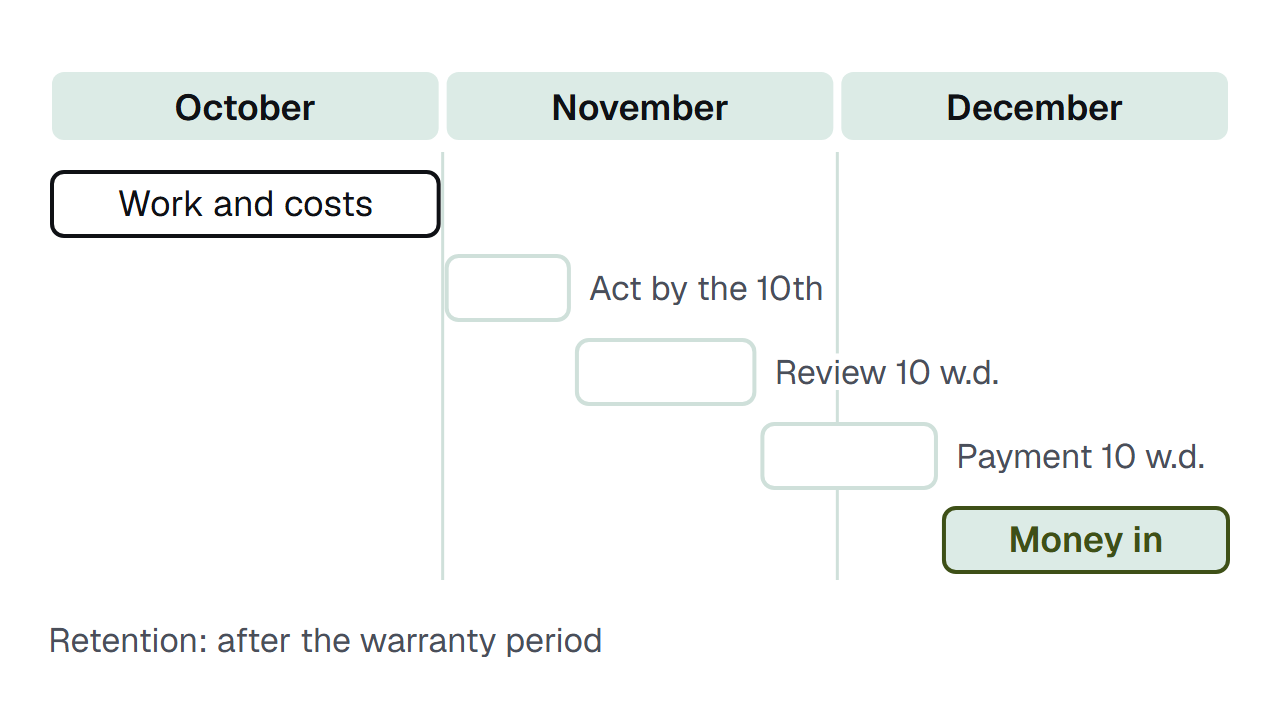
If the client uses every deadline, the money for October's work arrives in December. You pay for October's materials, wages and subcontractors in October. The retention only comes back after the warranty period ends, often several years later.
How to read a site's cash flow from the acts
Forma 3 shows every month how much the site has earned: the value of the work done. It does not show what the site has cost. That is in the supplier invoices, wages and subcontractor invoices recorded in the books, often with no note of which site they belong to.
If you write the site's actual costs next to Forma 3 each month, you see two things you would otherwise learn only after handover:
- Profit on each site. If 40% of the estimate is done but 55% of the planned costs are spent, the site is heading for an overrun, and you can see it now.
- Cash flow. How much money goes out this month and how much comes in two months from now. With several sites running at once, this is the number that tells you whether there will be money for wages next month.
The sample's "Naudas plūsma" sheet makes exactly this comparison for one site. The hard part is splitting costs by site: every invoice and every hour of work has to be tied to a site when it arises, not at the end of the month.
For one site, Excel will do. With ten sites it is ten files, and nobody sees the whole picture. How we set this up for all your sites in one view is described on the Construction cash flow page.
Frequently asked questions
Is Forma 2 mandatory? No law asks for "Forma 2" as such. The contract sets the act's form and deadlines. In public works contracts, Cabinet Regulation No. 419 requires a monthly act when the works last more than three months.
Who signs the act? Usually the contractor's site manager and the client. Many contracts also want the building supervisor to agree or sign it first.
When is the act due? As the contract says, usually by the 5th or the 10th. In public contracts by the 10th at the latest.
What if more was done than the estimate allows? That is additional work. It cannot go into the act above the estimate quantity: it needs an additional estimate or a contract amendment.
Can the act be signed electronically? Yes. A document with a secure electronic signature is equivalent to one signed by hand.